For those not in the spina bifida world there are actually 2 sets of numbers and letters to work with (actually maybe 4), which represent that lesion (where the spine was damaged) or level. One is motor ability and the other is sensory ability. Then there is actual level and functional level. Am I confusing you yet?
Some basics: The spine is made up of vertebrae (bones) that have letters and numbers. From the top down we have 8 cervical vertebrae (C1-C8), 12 thoracic vertebrae (T1-T12), 5 lumbar vertebrae (L1-L5) and 5 sacral (S1-S5).

The spinal cord and nerves are protected by the bony vertebrae. The nerves send messages back and forth to/from the body and brain.
Sensory lets your brain know what different parts of your body is feeling
Motor function lets you brain tell your body, muscles what to do.

The lesion means that the protecting bony part of the spine did not develop and the nerves are exposed and damaged. Unlike a spinal cord injury - where there is usually a clear line of function versus no-function, spina bifida can be patchy with lesion levels that might not equal functional level.
So what does it mean?
Sensory level is easy to determine, it just means what does someone actually feel.
Does an infant, child or adult feel when you touch? When you tickle?
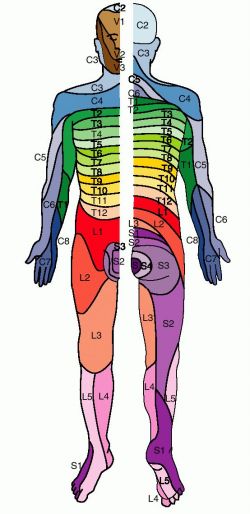
You can see from both these pictures that it is not a straight line.
The nerves feed into different muscles and part of the body and it is different at the front and the back of the legs.With Nickolas, I feel that he can feel down the front of his legs, and up the back of his calf, but nothing at the back of his thigh. So... that would give us about a S1 sensory level.
Functional level is a little tricky.
Muscles get messages from different nerves - this is called innervation.When I ask someone to give me a number and letter, they always tell me that it's their best guess. And with infants and children, it will take time to determine. There is also no clear-cut answer.
When scientists all got together in a room and drew all of these charts they had to draw a line in the sand and say 'this muscle = this vertebrae/nerve'
To get an idea of what I mean you can look at this medical illustration linked here.
+-+full.jpg)
The Spinal Hub website outlines exactly what function spinal nerves do to muscles. Also a powerpoint presentation here.
Vertebrae
|
Muscle
|
Function
|
C1
|
||
C2
|
||
C3
|
Diaphragm
|
Breathing
|
C4
|
Diaphragm/ Shoulder
|
Breathing/Shoulder
shrug
|
C5
|
Deltoid/
Biceps
|
Lift
arms, sideways/Bend elbow
|
C6
|
Wrist extensors
|
Lift wrist back
|
C7
|
Triceps
|
Straighten
elbow
|
C8
|
Hands/Fingers
|
Grip object
|
| Thoracic | ||
T1
|
Hands/Fingers
|
Splay
fingers apart
|
T2
|
Chest (intercostal)
|
Allow ribcage
move/breathe
|
T3
|
Chest
(intercostal)
|
Allow
ribcage move/breathe
|
T4
|
Chest (intercostal)
|
Allow ribcage
move/breathe
|
T5
|
Chest
(intercostal)
|
Allow
ribcage move/breathe
|
T6
|
Chest/ Abdomen
|
Ribcage move/Cough
|
T7
|
Chest/
Abdomen
|
Ribcage
move/Cough
|
T8
|
Chest/ Abdomen
|
Ribcage move/Cough
|
T9
|
Abdomen
|
Cough,
balance
|
T10
|
Abdomen
|
Cough, balance
|
T11
|
Abdomen
|
Cough,
balance
|
T12
|
Abdomen
|
Cough, balance
|
| Lumbar | ||
L1
|
Hip
|
Bends
hips
|
L2
|
Hip
|
Bend, flex hip joint
|
L3
|
Quadricep/Hip
adductors
|
Straighten
leg at knee
|
L4
|
Knee/Ankle
|
Bend ankle, draw foot
back (dorsi-flexion)
|
L5
|
Ankle/Toe
|
Lift
ankle/Lift big toe
|
| Sacral | ||
S1
|
Ankle/Toe
|
Bend
ankle/Point toe (plantar flexion)
|
S2
|
Toes/Anal, bladder
sphincter
|
|
S3
|
Anal,
Bladder sphincter
|
|
S4
|
Anal, Bladder
sphincter
|
|
S5
|
Anal,
Bladder sphincter
|
When you start looking up things like this, it is almost like you need a separate textbook to understand what these pictures are telling you! One site that was very interesting in the amount of depth of information came from medical school notes, found here.
I love medical students that put their studying online like flashcards here.

Plain English please!
All of those muscles get confusing!


Especially when your physio talks about 'oh I think there is definitely ____ muscles, not sure about ____ mucles' and you are trying to remember grade 12 biology. So Glutes, quadracepts, and hamstrings are the ones that stick out for me on those pictures.
Muscle Ability
|
Muscle Group
|
Nerve Innervation
|
Thigh
flexion
|
L1,
L2, L3, L4
|
|
Thigh
adduction
|
L2, L3, L4
|
|
Thigh
abduction
|
L4,
L5, S1
|
|
Extension
of leg at hip
|
Gluteus maximus
|
L5, S1, S2
|
Extension
of leg at knee
|
Quadriceps
|
L2,
L3, L4
|
Flexion
of leg at knee
|
Hamstrings
|
L4, L5, S1, S2
|
Dorsiflexion
of foot
|
L4,
L5, S1
|
|
Extension
of toes
|
L4, L5, S1
|
|
Plantar
flexion of foot
|
L5,
S1, S2
|
|
Flexion
of toes
|
L5, S1, S2
|
|
Anal
wink
|
S2,
S3, S4
|
Muscles receive messages from a number of nerves. Can't anything be easy?!
So trying to determine what a level is by what someone can do or feel is not as easy as the colourful pictures lead you to believe. If you are trying to determine the functional level that your child has, I am just repeating what I found online as well as what our physiotherapist explained to us. I used alot of this information to try to decode or translate what we were told - not to diagnose. (OK maybe I tried to diagnose a little bit when I didn't like what I was being told)
I looked at a bunch of articles that talked about flexion and extension and abduction/adduction. Then I had to look up what all of those meant, and then I had to look up pictures.
Abduction

Adduction

Knee extension

Knee flexion

Hip flexion


This is one of the most frustrating part when you are trying to imagine what you child will be able to do. All of this information and pictures and illustration will not let your child do something that their nerves will not allow them to do.
Labelling your child as a number and letter will not help anything (I can say this from experience and from fighting with myself about wanting a letter and a number). Being aware of what information is out there, and celebrating the achievements and abilities of your child and trying to educate yourself is what I hope people get out of this information post.

